I’m getting married to my partner later this year.
We were at her grandma’s a few days ago for her 87th birthday (big up!) and her grandma said, as grandmas do, ‘I wonder how many days it is to the wedding now, you must be so excited’.
Instead of saying yeah and moving on with my day, I remembered the countdown app I installed about 18 months ago and had the genius thought I’ll add the wedding to the countdown app so it will show me how many days are left until the wedding!
I reinstalled the app, opened it up, and boom – the one item I added into the countdown app, perhaps a year and a half ago:
Death – expected: 18,077 days left
Wed 16 Aug 2073
Eesh. Completely forgot about adding that in.
Counting the days
Around that time, 18 months ago, I had the idea that I wanted to find a ‘mortality’ app, one in which I could makeexplicit to myself the number of days I had left in my life vs. the average life expectancy. I wanted to remind myself of my mortality, and therefore give myself motivation to live more deeply.
Of course, I don’t know when I’m actually going to die, it is an estimate, and I estimated about the age of 80. In the UK men are looking on average at about 80.90 years, so that’s reasonable.
Unfortunately, I couldn’t find exactly the app I wanted, but I did find this standard countdown app into which I guess most people put things like ‘holiday’, or ‘birthday’, not ‘death’.
I appreciate some people may find this morbid, but I don’t at all. It’s all about framing. Yes, it is possible to look at it through the lens of something to dwell sadly on, but it is also possible to view it through the lens of my time is limited and precious, I must act now to live life on my terms.
Looked at another way, I could live life, do one thing I’m indifferent to after the next, not reflect on it and then one day keel over from a heart attack. I could also intentionally fill my life, my days, my minutes, my seconds with things that I honestly like and want to be doing. It doesn’t really matter to anyone except me. Only I can really tell the difference.
A stressor
However, it’s important to recognise that having a counter can be a stressor. For me, I can look at it and then feel the need to do a million things at once, but also simultaneously feel that I don’t have enough time, and angry at myself for not working out what it is I actually need to be doing. I want to be productive and conquer the world, but I also want to just chill and take it in, the wonder of simply being this miraculous concoction of particles. I think this frustrating feeling of urge-to-do-something-but-not-sure-what is just part of the buy-in cost, but it’s a good buy-in cost, because it’s telling me something and I have to work out what it’s telling me. On balance, I think knowing the days to the expected life expectancy is useful information to made explicit to myself, and then I can choose what to do with that information.
Back to reality
Look, I’m giving it all that with this high and mighty stuff, and it’s a nice idea, but I haven’t opened the app since I initially put ‘death’ in until now. That’s why it came as a bit of a shock when I opened it again the other day.
Anyway, folks, if I were to live to the average age of death in the UK, of which there is no guarantee, I have 18,077 days left to live. I wonder how many days you have?
We’d better use them wisely!
Also, I have 109 days until the wedding, as I then informed her 87 year old grandma.
Getting explicit, making things more visible, is what I’m doing with all this self-reflection / self-improvement .
Why do I meditate? The act of non-doing and simply noticing my thoughts is so I can explicitly see what the thoughts are and that they are just thoughts.
Why do I journal/write? The act of putting something down on paper makes my thoughts and intentions explicit.
It is so much easier to examine and question what is explicit and make choices about it.
It’s much more difficult to examine and question what is implicit.
Making things explicit puts the cards on the table.
Get explicit.
Note to self: This doesn’t mean immediately say what’s on your mind, getting explicit to other people about how much they annoy you. In this instance, I would suggest being explicit to yourself that you are annoyed, and what it is that annoys you. Then you can get explicit about the choices you have in front of you. Then you can make an explicit choice about how to proceed in a way that doesn’t compromise what you’re working towards.
I spent the last 10 days in the process of writing a post that I’ve ended up ditching. It started off on one point, but then meandered off somewhere else without really saying anything coherent.
And my response? I didn’t want anything to do with it. In fact, I set the whole enterprise aside and didn’t blog for a week. I got up a bit later than usual. I beat myself up over not blogging and used the excuse that it’s because of my new exercise routine. Funny though, while not blogging I managed to find just the right amount of time to exercise…
The truth of the matter – I’ve been getting up late because I didn’t want to deal with the post, and so I didn’t want to associate with it.
What didn’t I want to deal with?
I’d already put a lot of words down. I’d put a lot of time into it. I didn’t want to write any of that off.
I didn’t want to start with something new while I was still doing the draft. It felt like I was cheating on it. Guilty.
I felt like something was there, some coherence could have been found, but I’d have to do a lot of work to make it work, a lot of re-writing, a lot of heavy lifting.
The direction it went in got pretty heavy, so I was feeling heavy about it.
Apologies for the self-referential ‘blogging about blogging’, but let me re-frame it for you, for greater relevance, as blogging about a personally challenging endeavour. I assure you what I’m writing about is universal.
The cycle repeats
It’s not the first time I’ve done this. I have a ‘Drafts’ folder in Google Drive with, as of today, 9 semi-completed posts that I’ve abandoned. I know I went through a similar process with each of them as well i.e. writing, meandering, doing everything possible to avoid writing.
On reflection, I’ve had the insight that the core issue here for me is letting go. Jeez, I know, such a pop culture cliche, but actually so, so relevant to reality, because I see it absolutely everywhere – people not letting go of things that really they should be letting go of, myself included.
Letting go
It’s hard to let go. It’s really difficult.
Why? Three things I can think of:
Not being aware that there is a need to let go of something
Not being aware of what it is we need to let go of
Not being aware of how to let go
A note – you don’t have to go looking for (1) if (1) doesn’t exist. Maybe there is nothing to let go of, but sometimes there is.
Another note – even if we know (1), we might not know (2), and even if we know (2), we might not know (3).
A significant hurdle to the above is that we aren’t honest with ourselves. Unconsciously, we hide things from ourselves. I’m stretching into a we rather than I because while I know I do this, I know other people do it as well. Right now, I know that there are some hard truths that I’d rather avoid, lurking in the deep, dark depths of myself. I know that’s the same for other people. It is an issue because these things in our depths are strong determinants of what we do and how we think about our lives.
I know that if I want to live my best possible life, I must improve my understanding of myself, wipe off the dirt to see what is underneath, make it explicit, and then I can find my way.
Start from scratch
There are many contexts for letting go, from small to life-altering. Here are two from my life:
The financial model
A few years ago in my day job, I’d created a financial model for the company I worked for that had served its purpose for perhaps 6 months or so, but then couldn’t handle some significant iterations that were happening in the company. A lot of time had gone into building this model, and it had layer upon layer of smaller iterations. I took my boss through how difficult it would be to account for these significant iterations and he simply said start from scratch. Wow. Really? Start from scratch? That hadn’t even occurred to me. Are you sure? Yup. Sad I know, but this was actually freeing, a weight lifted, so much so that the memory really stuck with me. I re-designed the financial model with much better back-end (and front-end) functionality, such that it stuck around for the remaining 2 years I was there and is still in use today. And it was as easy as just being given permission to start afresh (albeit from an external authority – necessary in this context).
The best man
For the longest time, I envisioned that my best friend from secondary school was going to be my best man at my distant, future wedding. However, we fell out of contact after high school as I moved country and our lives separated, yet for years I still had this unchallenged vision of him as my best man. However, when I started more seriously considering proposing to my partner two years ago, my focus sharpened and I realised that I hadn’t spoken to the guy in maybe 6 or 7 years, and it had been even longer since we were super tight.
I wasn’t even aware of this need to let go of something, but on reflection I was hoping that one day our friendship would come back around. It didn’t. I realised I had to let go of this vision that had been there for 12 or so years, which was surprisingly painful, because it meant letting go of all the roots underneath the belief he would be my best man. It was entirely necessary though, because it didn’t align with the way things are.
Applying it to blogging
Blog posts are easier to ditch, because they don’t have such an upfront commitment of investment, but at the time it doesn’t feel like that. It feels like a mountain to climb. Will I ever be able to get through this?
However, the only way is through. Let me use the framing from above:
Not being aware that there is a need to let go of something
A good question here is what are my flashing warning lights? In my context:
Procrastinating on writing. If I haven’t written for, let’s say 2 days in a row, then the light starts flashing.
Feeling heavy about what I’m writing about. Clearly I have to have written something in the first place, so I can only work it out after I’ve been writing the draft for a bit, but if it doesn’t feel good, then the light starts flashing.
Not being aware of what it is we need to let go of
Here I have to challenge myself on whether the warning lights are flashing because of the draft itself, or something different. I have to diagnose, determine causality.
As part of that, I have to understand whether I’m walking through treacle but there is glory on the other side, or whether I’m walking through treacle for the sake of walking through treacle.
Not being aware of how to let go
I understand my warning lights are flashing and I have identified why it is they are flashing. Now I need to rectify. In my context:
Giving myself permission to not finish the draft, to start afresh. Forgiving myself for my inability to get to the end of a post. It’s okay. Really. It is.
Assessing the options in front of me:
I can continue to shovel shit to get the diamond underneath, but who knows for how long (I do want to at least be frequent with posting).
I can heavily revise the post, draw out a certain element and hone in on that
I can simply start another post that I am enthused about writing and move on.
Act on an option. The only way is through.
Through time, hopefully I can see the warning lights more quickly – I don’t want to be procrastinating for a week in heaviness. Clearly, great is great, but I’m okay with putting out something mediocre that I feel is good enough. I just don’t want to put out something I’m not happy with in the first place.
So that’s me. What about you? Do you have flashing warning lights? They might be worth checking out.
From a probability perspective, nothing that happens comes from a 0% probability of happening. Just because we can’t rub the dirt off ahead of time to see the probability of something happening lying underneath, doesn’t mean there isn’t a number there. Something with >0% probability of happening occurs because of pre-existing conditions allowing for that.
Everything comes from something. Hmm.
Mess in the morning
So I made a bit of a mess when making my morning smoothie. Stuff kept missing the fricking blender. As I kept missing the blender and cursing myself, I thought to myself about how my lovely partner loves to chides me about how I just never wipe the counter surfaces (the sides) down. She’s right – it’s a blind spot of mine. It’s not that I actively think I’m not going to do that, I just don’t think of it – unless it’s blatantly a horrific mess. In my defense, I’m good at doing the dishes. I’m not entirely hopeless.
Anyway, while cleaning up my smoothie mess, I had the thought that my inability to notice to clean the sides isn’t out of hate of cleaning the sides, or deliberately seeking to piss off my partner, but out of unawareness. The blind spot is unawareness, not noticing it. I’m simply unaware the sides are gagging to be wiped up until the point where even I can’t not see it.
Out of
Weirdly, the part of that thought I latched on to was the choice of the words out of. I have no idea where it came from, but it really just fired some feeling of insight in me. Out of is a funny phrase. Two piddly, basic words. One particularly common usage is when something is done out of spite i.e. I don’t clean the kitchen sides out of spite. Pah! Hardly a great endorsement.
But as I thought about it, out of is like an upgraded version of because. Out of strikes me as more lively. Because is dry, boring, but out of strikes me as describing something emerging, something being born. Something emerges out of some pre-existing thing. Everything comes from something.
Using out of
What’s crazy to me is how with the slightest of tweaks in semantics, lots of things can be uncovered, worlds can be shifted. Word choice and word order is powerful.
Maybe out of can be used more intentionally.
Maybe out of can be a useful aid in uncovering why I do the things I do, help me to understand my motivations intentionally or unintentionally. Maybe I can nurture motivations I actually want and minimise acting on motivations I don’t want.
Basically, I want to know who I am better. As laid out in The Statement, better understanding, particularly of myself, leads me to being better at doing in accordance with my honest wantings given what Is, which is what I want.
Better understanding comes from questioning in general. Better understanding of myself comes from questioning why I do what I do, why something is the way something is.
Sometimes though I struggle with answering the question ‘why?’ because…I…I don’t know why!
Maybe another weapon in my arsenal is to force my answer to begin with out of.
Let me give an example. I thought about why I’m making the smoothie (with protein powder), and it’s out of the belief I need to ram myself with protein to build muscle, as I’m currently working out quite a lot. Is this belief correct? I don’t know, but I can at least interrogate it if I make it explicit. It’s because of the belief, but it’s also out of the belief, my making of the smoothie emerges from the belief.
Whoa. Small word change. Irrelevant. Why bother writing this post?
I’m not saying answers are suddenly going to fall into my lap now because I’ve replaced because with out of – I’ll still need to actively engage with thinking about answering the questions. But I really like this idea of understanding my actions in the context of where they emerge, and out of helps frame that more than because. Also, because because is so drilled into my brain, using out of means I have to more cognitively structure my answer. It requires greater thought to make the thought make sense. Maybe I’m wrong, but maybe I’m right. Simple.
So practical steps? Trying this:
Why? Out of _______.
Sit back and actively listen to what your mind has to say. Let yourself be honest with yourself.
Why am I working out?
Out of my desire to look better and feel better, plus I enjoy it in the moment. I love moving my body. I feel better in myself when I’m moving around, not locked into my office seat for hours at a time, or the couch. This is out of my understanding, based on my past experience, and also from external authorities, that if I exercise then I will look better and feel better.
I could pick a raft of tangents here to delve deeper, but I’ll pick – Why do I desire to look better?
Out of knowing that when I see someone else who obviously works out, I’m like, fuck, they look good. Out of wanting to be desirable to other people – I want people to look at me and think fuck, he looks good. Why not? I’d rather be better looking than worse looking, and exercise is one of the tools in the arsenal for that. They absolutely may not think that, but I’d like for others to have that impression.
And I could dig deeper, and keep going. Why? Out of _____.
Why do I feel calm right now?
Out of not having much to do, maybe because it’s a Saturday.
But sometimes I don’t have much to do though and I don’t feel calm – why now?
Potentially out of not self-disciplining myself to achieve something? I have a yoga class (new year, new me) at 9.45am, it’s 7.25am right now – there’s no point doing much activity wise before then.
Why am I working on this post?
Out of the will to continue having something that is truly mine. Out of the will to give something of myself to the world that aligns to what I actually want to give to the world. Out of wanting to express myself outside the lens of the standard career path I’ve been following.
So give it a go. Everything comes from something. Let me know if any doors are opened for you.
The other day I finally put out a poster that my partner got me a year ago for Christmas, albeit on request. For my fear of messing up the walls, it remained out of the way and hidden, face against the wall, unloved and unviewed for a year and a month.
However, a week ago, I decided to change the set up in the second bedroom, the room where I work, and the poster finally received its opportunity for display on a side table.
I figure even if it disappears from my view when novelty fades, at least it has the opportunity to occasionally interrupt my thinking.
The poster is a quote from Carl Sagan’s Pale Blue Dot, overlaid on the Pale Blue Dot image, showing the Earth as a spot sitting in some kind of light beam. I specifically wanted this because at that moment in time, I really wanted some physical representation, a reminder that there is something beyond the trappings of everyday life. There is a whole fucking cosmos out there after all.
The last couple of hundred years has given us the privilege of making concrete our understanding of the infinity in which we sit – the concreteness of how small we really are, mere specks. Keep zooming out, further, and further, and further. Now try to find us.
This is what Is – we find ourselves within something that is just so incomprehensibly vast.
Incomprehension
So incomprehensibly vast.
And yet.
And yet I want to comprehend this vastness.
I don’t want to just intellectually comprehend this vastness, I want to comprehend it deep down, to feel it, experience it running through my body.
I want to know how to access feeling it, experiencing it.
I want to feel awe and wonder and marvel at the vastness and the joy for being alive as a mere speck.
I want to weep at the miracle of it all and feel fervour, because as we are mere specks life is more precious, not less.
I also want quiet contentment – simple, serene acceptance that I exist within this vastness.
I don’t want the novelty of this thought to fade, entering my consciousness every now and then. I want to be conscious of it.
Juxtaposition
And yet, when I look at the current moment, it feels impossible to gain even a slight amount of access to this awe and wonder and marvel and joy for being alive. I’m in my 2 bed flat in London on a cloudy winter day, having just stared at my computer screen for six hours, moving numbers around a spreadsheet and pinging firefighting emails out. I’ve been sucked in, spit back out and then sucked back in. My eyes are tired and I’m irritable. I’ve been sitting down for most of the day. The little daylight there is out the window is fading. Even if my mind can explain to me that there is vastness, I am within it right now, I am it, to me it feels like just a high and mighty thought, beyond me and my surroundings. And experiencing the vastness running through my body? Jog on mate.
In my everyday life, I experience many moments of not considering the vastness in which I find myself, let alone comprehending it. However, if I really think about it, I honestly want to reconcile my everyday life with the feeling of being part of the vastness of the universe – make one agree to the other.
The plan
So then the question is now I’ve established what I want, how do I actually set about my doing in accordance with this?
The base of my thinking is that I have to start with cultivating my intellectual understanding, and gradually from that it will sink in more deeply.
Noticing – notice that this is what Is – there is vastness, I am in the vastness, I am the vastness. Without noticing this and focussing on it, it won’t be the thing that I consider. I’m going to set a reminder on my phone. Towards the late afternoon is when I feel the most distant from the vastness, so it will be most difficult to access this feeling. This is exactly when I should take some time to notice. In the early morning or late evening is when I find it easiest, I should do it then to reinforce.
Allowing the thought to sit – When focussing on it, I have to make the choice to give time to this thought to sit in my mind, to hold it in my mind’s eye, to mull it over. I have to prioritise it over whatever work I’m doing, even if I feel guilty because I think I should be working or doing something else. I’m going to set a timer for 5 minutes. If I get real with myself, it’s only 5 minutes, and this is my priority, so screw everything else. I will go sit in a bathroom or walk around outside or wherever. I think reducing distractions is key: no people, phone, whatever else.
Environment placing – The other strand to follow is that I’m more likely to notice vastness when I’m in vast surroundings – big skies, open country, naturally big things e.g. the sea or mountains. Living in the city at mostly ground level, I’m consistently walled in, and if I am higher up, then I’m behind glass. I have to actively put myself in vast spaces, which I’m going to self-define as not having buildings or any other objects blocking my line of view of the horizon. I need to work out where my nearest vast spots are, and then place myself there.
Everything Carl Sagan said was correct – The Earth is a very small stage in a vast cosmic arena. This is what the poster brings – the vastness into a place that doesn’t feel vast. Let’s see if I’m able to utilise the poster as I intended!
This is a good example of me not doing in accordance with my honest wantings given what Is, per my previous post.
I live in a ground floor apartment of an older two storey building. Given it is older, unfortunately, there is quite a lot of pass-through noise between the floors. Often, we can hear the guy who lives in the apartment upstairs walking around, listening to his TV etc. It’s not every day or night, but it does happen. I go to bed relatively early, but I can usually live with it when it does happen. I put earbuds in which does the job.
Last night though, he was doing something that sounded like bouncing a tennis ball against the floor, repeatedly. Maybe he was hitting the heel of his foot on the floor when sitting or laying down on a couch. It wasn’t heavy enough to be him full on jumping. Anyway. There was this noise, but then it would stop……..and then it would start again. It woke me up. It was 1.30am. It stopped and started again. Stopped and then started again. It kept going. Urgh.
I lay in bed, not doing anything, i.e. doing lying and seething and hoping it would end. After a while I put my earbuds in as they were by my bed, but that didn’t solve it tonight. The noise was too sharp and distinct against the backdrop of silence.
Bump-bump, bump. BUMP. Bump…………Bump-Bump……………………..Bump. Bump. Bump. etc.
I didn’t want to get out my warm, cozy bed to get my headphones in the other room i.e. I wanted to stay in bed. I didn’t want to tell the guy to stop whatever he was doing i.e. I wanted to stay in bed and avoid getting into a potential argument at 2am (don’t tell me how to live my own life in my own apartment!). When I’m super-tired I’m liable to go into it with a ‘what the fuck are you doing, moron’ kind of mindset. That might not be bad, but the last thing I want to do is create some kind of reactance where he starts doing things like that on purpose once he knows how easy it is to create disturbance. He is in the upstairs flat and therefore has the power to make noise on a whim. Some people are just like that, and he is like that. In fact, I really would just rather not interact with him at all. Let’s just say from previous interactions he strikes me as an irrational and hot-headed type of guy.
On the other hand, I wanted to sleep, understandably. I wanted to get up at 6am so I could write. From experience, I know that my grogginess for the day was becoming more likely, which I didn’t want. This was upsetting me. I also interpreted that it was an avoidable disruption, the guy could simply not be doing that in the first place. It was unfair. I was seething.
Now I hadn’t communicated that I wanted him to stop, so I was hoping he would stop…just because? Because he should go to bed! It’s 2.30am man, why are you just up chilling by yourself, bouncing something, on a weekday? Because he should know that making noise on the floor impacts people downstairs! I was also upset with myself for not actioning that.
I was semi-conscious of all these thoughts, all these thoughts cycling through my mind for an hour and a half while I lay in bed, warm and cozy.
However, despite recognising all that, I didn’t consciously ask myself the most important question: is this what I honestly wanted? To lie in bed, seething, mind racing with negative, circular thoughts? No, I honestly wanted to sleep. I’m predisposed to do that shit. I feel better on 7.5-8 hours, worse on 3-4 hours. This is what I needed to prioritise. I already knew the two solutions after five minutes – either go get my headphones from the other room or communicate with the guy to make him aware that he needs to stop whatever the fuck he is doing.
It was 2.50am when I finally decided to get my headphones and put some background noise on. Finally. It worked, as I knew it would. I changed my doing from listening to the upstairs noise and seething, to listening to background noise and not seething, which allowed me to go back to sleep. Unfortunately, it also then meant that I woke up a lot, because the earphones pressed into my ear uncomfortably, so everytime I rolled over I stirred. Better than nothing. Also not ideal. I picked a sort of in-between solution. I solved my immediate problem, but created more problems for myself.
I was not living in accordance with my honest wantings given what Is.
If I’m really honest with myself, l want to address the root of the problem, which means communicating with the guy upstairs. Without communicating with him about it, how is he going to know that it needs to be solved? I really want to do that skillfully so he doesn’t have reactance. I can address it with him in day time, so I’m not tired. This is what I need to prioritise. It’s one thing knowing this though. I know that this is what I honestly want, but I need to actually do in accordance with that for it to become reality.
Alas, doing in accordance with my honest wantings is not the easy life.
This is the moment where it all makes a bit more sense to me.
This is the moment I understand why pursuing awareness matters.
It has taken me a very long time, years, to get to this point of explicitly recognising it.
I have tried to be precise as possible in my wording to make it as actionable as possible.
The statement of my life
This is what I’m trying to achieve in life:
Doing in accordance with my honest wantings given what Is.
It is the statement. It is the statement of my life.
Laughably simple.
So unremarkable.
So difficult to achieve.
It will take a lifetime of effort to:
be conscious of the elements within the statement.
to increase my clarity of the elements within the statement.
to do according to the elements within the statement.
It will be worth it though. It holds most, if not all of the keys to a good life. Every moment I can look at myself in a curious manner and ascertain whether I am holding true to the statement. Can I truthfully say I’m living the statement right now? Deep down I know how honest I’m being. If I’m not holding true, then I know under which stones I need to look in order to pursue to make the statement more truthful.
I’m already living the statement. You are already living the statement. Consciously or unconsciously, explicitly or implicitly, to some degree of success. Sometimes you live it, sometimes you don’t. It is continuous. You can be living it very successfully but be completely ignorant of all of this, or living it very unsuccessfully but have complete clarity of it. However, if you have complete clarity of it, then you would also have a very good idea on how to pull yourself up to living it, and surely that’s a much better position to be in.
The elements
The statement is made up of a few separate elements:
Doing / in accordance with / my honest wantings / given what Is.
Let’s have a look at them in more detail:
Doing
From birth to death, i.e. when we’re alive, we’re always doing something. We can never not be doing anything. I’m not doing anything, just chilling on the couch. No! You’re doing chilling on the couch. That’s what living is – a continuous flow of doing. We’re always doing something in this very moment.
I used to think that doing is something physical and thinking is something separate in the mind.
No, thinking is a subset of doing. The mind is also part of the physical body – its activities are also physical. Hmmm, really? Let’s test that.
I’m absent-mindedly thinking about what to cook for dinner. Try that.
Okay, you’re doing the act of thinking about what to cook for dinner. Make sense?
You’re probably doing the act of drooling as well. It’s a language limitation: doing thinking or doing breathing sounds clunky (two gerund -ing verbs together?) and therefore incorrect. Doing the act of thinking, doing the act of breathing unlocks that door. Every verb we use to describe our activities: sleeping, drinking, crying, reading, listening, lying, showering, typing, they are all variations of the core act of our doing.
We can be doing multiple things simultaneously. You can be walking to the shop, thinking about what to cook for dinner and also drooling. That happens. That’s allowed. We’re always doing.
Given what Is
It makes sense to tackle given what Is before my honest wantings.
What Is
What Is is everything. It is the universe. It is right here, right now. I’m capitalising the verb Is, as in the present of ‘to be’, because I want to honour the magnitude of it. I am. You are. Everything else is. We’re all what Is.
It’s when I sit back, look around at my surroundings and say ‘wow, this is what Is’. No judgment. This is where I am. This is who I am. This is the room I’m in. This is the Earth. This is the universe. This Is.
What Isis beyond the control of my consciousness, but my consciousness is part of Is, because my consciousness is part of my mind, and my mind is part of my physical body, and my physical body is part of the universe. I find myself in the universe because I am the universe. I don’t exist beyond the universe. How incredible is that?!
Given: beyond our control
Is is a continuous flow of moments, one to the next. In this flow of moments, there is this particular moment: right now. The funny thing is I can’t change right now. It simply is, like a photo, a snapshot. It is where we find ourselves.
Hmm, really? Let’s test that. Okay. If I find myself feeling thirsty, I can respond by bringing the glass of water to my lips, but the act of bringing the glass of water my lips is in the future flows of Is. I am responding to the photo, the snapshot, through doing, but not in the very right now. Then the water is passing through my lips and going into my throat. That is what is happening right now, I can’t change that unless I take the glass away from my lips in the future flow of moments. We can only ever respond to right now. It is beyond our control, our ability to influence.
This is what I mean by givenwhat Is. We are absolutely constrained by everything beyond our control. If I were to have a painful cut on my arm, then in this moment I can’t change that to not having a painful cut on my arm. It’s simply what Is. If I’m feeling overly stuffed after eating a greasy pizza (like right now), that feeling is part of what Is. It sucks, but it is what Is. Damn.
So what exactly is it that’s beyond our control?
A lot of stuff happens beyond our control. I bucket it into three areas: the external world, stuff in our internal world, and our predisposed interpretation.
The external world is the physical world beyond us. It’s everything that can be internally processed through our sensory inputs e.g. ears, eyes, nose, mouth, touch, proprioception.
The internal world is the grouping of things that happen within our body that originate beyond our control. It’s the stuff that arises automatically within us. This includes things like ‘arising thoughts’, ‘arising emotions’, ‘arising feelings’, ‘arising impulses’. They just happen within us and we don’t know where they come from, we just suddenly become aware that we’re half-way through a thought-stream. I nod here to neuroscience, as that field has made it clear that a lot of stuff that occurs within us is the result of how physical chemicals move and are processed around our body.
Our predisposed interpretation is when we take these external world happenings and internal world happenings and internally process them in our mind in an attempt to make it make sense to us.
Our interpreting is going to be skewed no matter what we do, because we can only ever interpret based on how we do our interpreting. What shapes our interpreting? Our predisposition. What is our predisposition? It’s who we are at this moment in time – in the snapshot of now.
We were born with a certain lay of the land, passed down from our ancestors and parents, but then through our life experience, from birth to this moment, that lay of our land shifts. This shifting is due to us living the statement in the flow of moments from birth up to now. Our view of given what Is has changed. We now have a very particular shaping to the lay of our land, unique. This lay of our land is our predisposition.
So what do I control?
Doing right now.
Doing is our source of power, our source of determining our lives.
This might sound painfully obvious, but sometimes we need to remind ourselves of the obvious things by making them explicit: Doing is literally the only thing we can do.
Doing is where we have the opportunity of choosing what to do.
Doing is expressing ourselves.
Wantings
This is the clincher. Wantings are what determine whether we live the statement truthfully. You can simply be doing given what Is, I mean you are, but there’s something more to the human experience I want to draw out. I’ve called it wantings for brevity, but wantings encapsulates everything along the lines of needs, wants, likes, ideals, beliefs, aspirations. I’ve used wanting as a verb to reflect that they don’t rest in steady state, they exist continuously in the present and shape shift.
There are two sources of wantings: predisposed wantings and aspirational wantings.
Predisposed wantings
Predisposed wantings originate in that internal world beyond our control in what Is, hence why I covered what Is first. They originate automatically, unconsciously. We simply can’t help it. They arise within us in the form of arising thoughts, emotions, feelings, impulses etc. These arise based on our current predisposition. As a reminder, our predisposition is the lay of our land in this moment. The predisposed wantings come in different forms:
Our bodies: Hunger, thirst, bodily functions
Our conditioned behavioural patterns:
the automatic arising feeling of shyness, the predisposed thought to avoid the conversation that’s causing the feeling of shyness, the unconscious wanting to avoid conversation.
The milk spilling on the floor, the automatic arising feeling of frustration, the unconscious wanting to express my frustration through sighing
Liking ice cream, so if presented with ice cream when hungry, the arising urge to satisfy my sweet tooth, the unconscious wanting to eat the ice cream
Fulfilling these wantings i.e. doing in accordance with them would align to how we are predisposed.
This isn’t the end of the story, however. Wantings are not static. Our wantings are ephemeral, they change through time, both in the short-term, moment to moment, and in the long-term, through our lives. With our predisposed wantings, just because this is the lay of our land right now, it doesn’t mean that things can’t or won’t change. This is evidenced by how we’ve changed from being a 3 year old to now being an adult. Shiny, plastic trinkets (mostly) don’t cut it anymore to keep me entertained for hours on end. My predisposed wantings will be slightly different in a year, and potentially very different in 10 years. And how is our predisposition changed? It will change through our living out the statement.
Aspirational wantings
Okay, so we have these predisposed wantings that are beyond our control, so we just go ahead acting on them and things will be okay, right? Well, no. Sometimes we want to do something, e.g. we have a violent impulse to hit somone, we really want to hit them, but do we? No. We don’t do hitting. We do not hitting. Why?
We can want things that when fulfilled, do not align to our current shaping, our predisposition. We have ways of doing and being that we aspire to. These are our aspirational wantings. Beliefs. Ideals. We have ideas of how we would like to be different, not comfortable with the lay of our land and doing according to the lay of our land. I want to be a peace-loving guy. That is an ideal I want to embody. If that is an aspirational wanting for me, and I live it and make choices according to it, then there’s a good chance it will slowly seep into my predisposition alongside everything else. Maybe not though.
I originally called this conscious wantings, but I am not necessarily conscious of them.
Aspirational vs predisposed
Aspirational wantings sound great and predisposed wantings sound shit. Why have you used ‘my honest wantings’ and not ‘aspirational’?
Aspirational doesn’t mean good. Predisposed doesn’t mean bad. They are just words to describe the source of the wantings. Aspirational wantings can create a crazy code of rules of ‘shoulds’ and ‘musts’, which don’t necessarily serve us very well, and can create a lot of bad feeling in us. Therefore, it’s really important to focus on our honest wantings.
‘My honest’ wantings
What are you on about with honest wantings? Why is it necessary to include ‘my honest’?
We have a lot of wantings, predisposed and aspirational, and a lot of the time they seem to contradict each other. There is a high potential for suffering here, as we can only ever act one way in the moment,and therefore there’s a high potential for at least one of our current wantings to not be satisfied. It really is zero-sum. There are infinite possibilities of what we could do in the next flow of moments, but we only ever action one of them. We have to choose to eat the ice cream we love because we love ice cream or to not eat the ice cream we love because we believe we’d be out of balance in the long run if we ate it.
We have to prioritise our wantings. What do we honestly want given that there are so many things we want right now? Being honest with ourselves about which wantings we want allows for us to have peace when we prioritise one over the other. If I’m peace-loving and don’t hit the guy, while I have to suck up the temporary arising feelings of annoyance and frustration about not hitting him, I’m servicing my aspiration of being peace-loving, and that is fine, because I can look into my eyes in the mirror in my mind and say this is honestly what I want.
You may find yourself in what Is with many wantings that are of equivalent preference. Good for you. It doesn’t matter which one you action, you can do them and not end up feeling regret.
You can be conscious of all this or not. It’s happening regardless.
It’s important to also recognise the ‘my’ in ‘my honest wantings’. My honest wantings are not anyone elses. Just because my partner wants to go to the store, it doesn’t mean I want to go to the store. Just because I’m an employee and the want of the business is to serve the customer, it doesn’t mean I, the thing I know as me, necessarily wants to serve the customer. It has to be me and only me. A lot of the time, we are doing things because we think that is what we should be doing, or for someone else, when in fact we are completely indifferent to it, or directly don’t want to do it. The truth is when we look in the mirror of our minds. We could be spending our lives doing something that more closely aligns with what we want.
We may honestly want to make our partner happy, but if it’s coming from a place of fear, interpreting that they’ll be angry with us and they’ll abandon us if we don’t do it, then we need to question our interpretation. If the wants of our partner always takes priority, then we need to question what our honest wantings are.
Why does it matter?
Why does it matter to live in accordance with our honesting wantings given what Is?
Because if you figure it out, and live it consistently, then there isn’t anything else to do. Just think about that.
You are doing everything you can, given where you are, to live the life you honestly want to lead.
This is an end in itself.
A life just is, and relativity doesn’t actually exist, but to me it’s pretty clear that you can choose what to do and how to do it, and because of that, you can shape a great life or a rubbish life from your choices. I think everyone would agree that everyone’s interpretation of great and rubbish are different, but I think it’d hard to disagree that if we did what we most wanted given what Is, then that is better than doing something we didn’t want as much.
I might be overreaching, but I think we’d all prefer to live a life experiencing only a little avoidable self-imposed misery, rather than experience a lot of avoidable self-imposed misery.
For example, maybe you feel duty bound to spend lots of time with someone who makes you miserable. On reflection you’re doing in accordance with the wanting to avoid conflict with that person by telling them you don’t want to hang out with them as much anymore. What you actually really honestly want to be doing is spending your time painting, so you could be doing that instead. Your life would look much better if you could do your painting, and not be with that other person who makes you miserable.
You don’t know how to break free of your misery though, until one day you have that thought that perhaps you are not acting on your honest wantings because your interpretation is wrong, you are merely imagining being shouted out or something which may or may not happen, but regardless, even if it does happen, it doesn’t matter. In fact, there is nothing in what Is that stops you from simply acting out in accordance more honestly with yourself.
It’s all in balance though. I do live in the real world, after all. We will never 100% of the time be able to be living this statement. It’s simply not possible (would love to be proven wrong).
We are aiming for consistency, not always.
Knowing this statement gives us a tool for assessing where we stand – are we falling short of it? Are we successful?
So what now? How do I make the statement a reality?
The levers
Look, we can unconsciously and ignorantly happen to do in accordance with our honest wantings given what Is. That happens. It happens all the time. Sometimes you put in the work – you’ve been reading lots of books, you’ve been journaling, you’ve been meditating, and still don’t feel any better off, but then someone you know who clearly doesn’t give a fuck about any of that stuff, who just lives their life, they just have it figured, they’ve hit the sweet spot and life is just great for them. It might not be true, but they at least seem happy, content, and self-assured. Good for them – honestly.
Put simply though, wouldn’t it be better to be conscious and knowledgeable of why we’ve hit the sweet spot? That way, if we fall off track, then we can work on how to get back on track? We can work out how to get there in the first place?
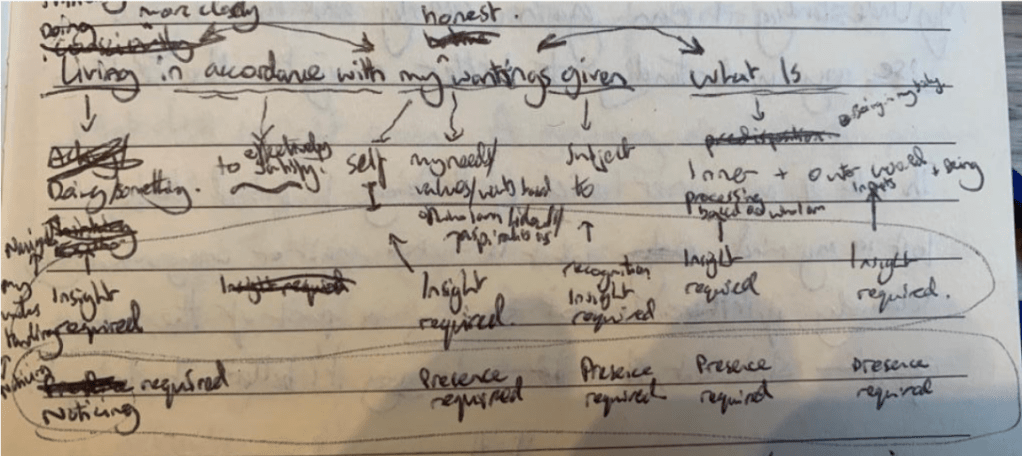
There are three levers that allow us to more closely align ourselves with living this statement: being consciously aware, understanding, and doing.
I imagine being consciously aware as and understanding as two separate layers under each element of the statement (Doing / my honest wanting / given what Is). Being consciously aware is the bedrock and understanding sits on top of it. Doing is already within the statement.
Being consciously aware – This is all about shining a light. Without awareness we can’t understand, which means we don’t understand how to effectively do in order to make our doing aligned with our honest wantings given what Is. We can be aware of i) what we are doing, ii) what our honest wantings are, and iii) what Is i.e. the external world, the internal arisings and our internal interpreting. We can consciously be aware in choosing our doing and in choosing our aspirational wantings.
Understanding – We develop insights into our life: oh wow, I though the world worked this way, but it actually works that way! Or if I watch a documentary on a murder, I feel sad, and I don’t want to feel sad. Therefore I shouldn’t watch a documentary on murder. You build all these insights into a composite overall understanding, a collage, you are either consciously aware of or not. Like your interpreting, your understanding is skewed by virtue of all your insights being uniquely acquired and collated.
Being consciously aware allows for cultivating further insights. It allows us to acquire new insights, either completely from left field, or to connect the dots on old insights to form new insights. The more insights we can build into our understanding of our doing, our honest wantings, our external world, our internal world and our interpreting, the more we can change our doing to be in accordance with them.
In my view, some insights are more useful than others in the context of living the statement. The judgement of whether something is more useful is on how useful it is to bringing you up to living the statement.
Doing – we are doing. I’m either OK with what I’m doing right now or not OK with it. If I’m honestly OK with it, great, but if I’m not OK with it, it is at least 1% possible for me right now to do something different than what I am currently doing; to change what I’m physically doing, to change the thoughts I’m doing. We can do the act of moving ourselves into a different environment. We can do anything (given what Is).
What actionable things can I do?
The steps that can be done I’ll bucket by the levers. However, literally every self-help book will have their own spin on this, on top of inputs from just your life as it is.
These actions can be applied to each element: Living / in accordance with / my honest wantings / given / what Is.
Being consciously aware
The aim is to be in the present moment with the recognition that it is hard to be consistently in the present moment, so there is no need to beat yourself up over it. The core of it is activelynoticing. You have to notice something, and it’s exceptionally difficult to notice everything, I’m not even sure it’s possible, so choose something in particular to notice. Let noticing seep into your life.
A few routes to allowing noticing to seep into your life:
Set external reminders to notice and then actively notice.
Set aside time to practice just being aware (otherwise known as meditation practice) – actively notice during this time
Literally slow down. Do things slowly – actively notice what you are doing
Ideas for what to notice:
Notice the breath
Notice the feeling of a body part
Notice something in the external world
Notice what your body is doing in the external world – this is where your physical doing is visible to you
Notice what is happening inside – this is where wantings and what Is (internal world, interpretation) tend to become visible to you
Notice your arising thoughts and thought patterns – this is where wantings and what Is tend to become visible to you
Understanding
The aim is to challenge our current understanding and build a better understanding of what we’re doing, our honest wantings, and what Is. The core of it is asking challenging questions and explicitly responding. You can only ask one challenging question at a time. Don’t be afraid to re-phrase questions. Let questioning seep into your life.
A few routes to allowing asking challenging questions and explicitly responding to seep into your life:
Ask yourself questions in the moment
Set aside time to ask focussed questions – if I was unconstrained, what would I really want in this moment?
Set aside time to let your mind roam freely and come up with insights and epiphanies itself to be examined e.g. while walking, cleaning, doing a repetitive task
Write down your understanding – long-term structured – ask yourself focussed questions in a journal, blog, core document that really requires days of thought and reflection and development
Write down your understanding – short-term structured – e.g. a daily set question like ‘3 things to be grateful for’
Write down your understanding – unstructured – e.g. free-flow morning pages journal
Read, watch, converse – interact with different viewpoints and perspectives
Ideas for questions – you can add in ‘not’ as well e.g. what am I ‘not’ doing
Doing
What am I doing?
Why am I doing this?
Am I doing in accordance with my wanting?
Why am I not doing in accordance with my wanting?
Wanting
What am I wanting?
Why am I wanting?
What do I want to prioritise?
Why do I want to prioritise it?
Is this just now or is this repeated?
Given what Is
Where am I?
In what scenario do I find myself?
What is in my control?
What is out of my control?
What Is?
Why am I having these arising thoughts?
What is my interpretation?
Is my interpretation wrong?
Why do I think this?
Why do I feel this way?
Doing
Our doing is always there, it is constant. The aim of our doing is to do according to our honesting wanting given what Is. The core of it is doing.
Ideas for doing:
Change how you physically exist in the external world – even just move your body slightly
Change how we are thinking about something – drop in any thought deliberately
Final thoughts
I’m the same as you. I’m just living my life and trying to make my way through it the best I can. The statement, doing in accordance with my honesting wantings given what Is, is an observation. Just because I recognise it and have made it explicit doesn’t mean I will be successful with it. It’s really hard. We float in and out of awareness. Our understanding of ourselves is often poor, to bring it to something workable can take a lifetime, and sometimes it can never happen. When I write my honest wantings, I’m thinking of muddy water.
However, I have hope. I imagine myself as an archeologist, wading through those muddy waters, sifting through the silt. It’s back-breaking work, but occasionally, you’re sifting and, wow, is that something? Yes, yes, come look at this! It’s a prized fossil!
Today is the first day back from a 13 day holiday in Sri Lanka. Wow. What a great place. I would highly recommend.
I have this understanding of holiday breaks where I only reach the point of complete refreshment after 10 days or so. It’s the moment of realising it’s 5pm and I actually have no idea what day it is….is it a Tuesday or a Saturday?! The standard markers of passing time fade away. I am just existing. Thankfully, I reached that point on this trip, which was great. It also reminds me that it is good for me to aim to have at least one 2 week break every year.
It is also good for me to have a few days of just rest. Literally not doing much at all; not trying to fit in a packed itinerary of bouncing from place to place, seeing all I can see. It’s actually fine for me to just lie on a beach and let the world go by, to read my book, to eat some good food, and to stay in the hotel room if I want to, which I did. Did I ‘do Sri Lanka’? A younger version of me would have scoffed that I didn’t try to integrate more into the Sri Lankan culture, go to more local Sri Lankan restaurants and make more friends with random people in hostels. Now? I guess I got what I needed, which was rest and a chance to cultivate fresh eyes by doing something different.
I loved spending more of my day being more in my body – I did a lot of yoga and surfing. When I say surfing, I mean I got thrown around in the waves a lot. That doesn’t matter though, what I loved was the state of non-thinking, just being so there. It’s very hard to be elsewhere, especially when you’re getting churned up in the waves. Also, I have a lot more appreciation now that while the basics of standing up on a surf board can be easy to achieve, becoming good at surfing is a whole different story, and likely years in the making. It’s a shame that London is far away from a decent surf spot! It could be a good idea for me to find activities that make it very hard for me to be elsewhere.
Not Nice
I read Not Nice by Aziz Gazipura while in Sri Lanka. On first reading I really had a lot of ‘huh’ moments, where it felt like I was basically reading about myself and then was being presented with an alternative way to approach the world. The book was full of personal anecdotes that were relatable, and I definitely intend to make notes and try to incorporate some of these things into my life. I have definitely also said that about 50 books I still haven’t got back to, but this time it’s different! The concepts will probably fall through into this blog in some form or other in the future.
Reflections
I also got plenty of time on holiday to actively reflect. In mid-December I was trying to write another post on self-help traps, and I was asking myself what did I want to solve with self-help? Over the following weeks I forgot that this was the question I asked (until writing this), but I have been trying to develop an answer, which has proven to be a journey. I will share where I am up to in this journey in a later blog post.
The other day I was reading Start Where You Are by Pema Chodron, and one of the chapters is about ‘lighten up’ and play, and it reminded me of a previous thought I had had about introducing more play, more frivolity into my life, as I can be very serious for long stretches of time. Urgh, I cringe writing this, but I’m often seriously thinking about trying to be more one with the universe, becoming more aware, thinking about saving money, thinking about how to manage colleagues at work, thinking about the work itself, being the sensible one (that’s the role I seem to inhabit in my relationship). A lot of logistics. Not much play.
Sure, I go see friends and have a laugh, but I’m not talking about ‘play’ in the sense of ‘play time’ i.e. leisure. I mean play in terms of the ‘sense of play’, ‘being playful’. I don’t know what the strict definition is, but for me it means a feeling of lightness, a cheekiness, laughter, creativity, collaboration, fun, warmth, joy.
There is a time and place for it, but I think that there’s a lot more time and place for it than I would presume, maybe like 80-90% of the time and place. Even if there’s noone around, I can still be playful with myself. Why not?
Where is the sense of play?
Anyway, the main point I wanted to get at here was that I wanted to have this sense of play. So I asked myself where is the sense of play in me? I don’t know how to describe it, but I just kind of started trying to find it in me, scanning my body-mind for it.
Ummm….nope, not there….no, not there either…hmm. Maybe it’s because asking the question to my intellect is not going to just make it appear? Let me test that by asking ‘where is the sense of seriousness in me?’ BAM. Okay, so that’s right there in my face. I found that immediately. So serious, I can feel it in my breathing. Okay. Hmm. What about, ‘where is the sense of indifference in me?’ Ooooo, yeah. I feel that one right there in my chest. I’m not surprised that’s there. ‘Where is the sense of tiredness in me?’ Yeah, around my eyes (it was on my commute back from the office). Check.
So asking the question ‘where is the sense of x’ is actually a useful prompt for identifying where something is within me if I ask. Who knew. I can find the sense of indifference, the seriousness, the tiredness, so where’s the sense of play in me?
No but really, where is it?
I realised I couldn’t find it anywhere. There was no sense of play in me in that moment. I felt a bit sad about this, because man, that’s a bit sad. However, I wasn’t floored, because I have experienced a sense of play before, so I know that it is in me somewhere, and I also know what it is when it’s here, so I know I’ll recognise it, and I know that having a sense of something comes and goes – so I have hope.
It’s quite amusing, all this seriousness about thinking about how important joy is and how to experience joy, and yet I have no sense of play to unlock the joy!
I kept asking myself over the course of three days, ‘where’s the sense of play in me’? And it kept not being there. Until one time I noticed something. It was somewhere around my solar plexus. I imagine it’s kind of like going fishing – the moment when you’ve been waiting hours for a bite and suddenly the line goes taut. Low key exhilaration. I was like, aha, I have found play. I let it be for a moment, but then I had the realisation that I could also act on the play, indulge it, carry it further. I was by myself on the Tube commuting, so I just basked in the feeling of lightness of it, entertaining myself with amusing thoughts.
And then the next day at work I felt it again, and because I was with someone who I could be playful with, it was fun. I definitely want to spend more time being playful, but with the recognition it’s a process, not a permanent thing.
As I write this, I also had the realisation that when I’m playing – that is undoubtedly me. I mean, when I’m serious it’s me as well, of course it’s all me, but when I feel playful it feels like me expressing my self. My personality shines through. I have a confidence because I’m being who I am. My barriers to the outer world feel less imposing.
Takeaways
So my takeaways here are:
‘Where is the sense of x in me?’ is a really amazing question, for in the moment, to help me identify whether I am feeling a sense of something or not.
Play is a really good sense for me to be on the hunt for because I’m apt to lose it and it feels really good when I’m playful.
I have a feeling that asking the question encourages the playful seed to grow a bit, and if it doesn’t, then I need to reflect on whether I’m putting myself in the conditions to allow the seed to grow.


 Pursuing Awareness
Leave a comment