This is it.
This is the moment where it all makes a bit more sense to me.
This is the moment I understand why pursuing awareness matters.
It has taken me a very long time, years, to get to this point of explicitly recognising it.
I have tried to be precise as possible in my wording to make it as actionable as possible.
The statement of my life
This is what I’m trying to achieve in life:
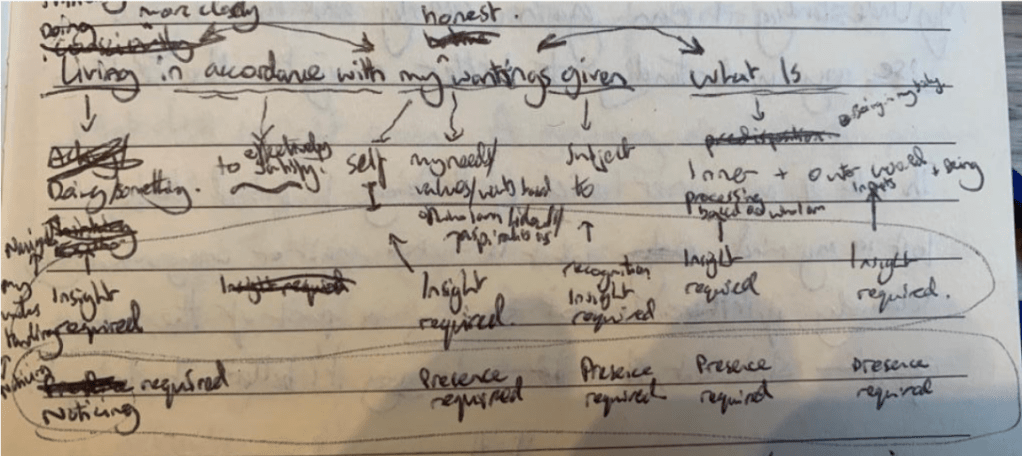
Doing in accordance with my honest wantings given what Is.
It is the statement. It is the statement of my life.
Laughably simple.
So unremarkable.
So difficult to achieve.
It will take a lifetime of effort to:
- be conscious of the elements within the statement.
- to increase my clarity of the elements within the statement.
- to do according to the elements within the statement.
It will be worth it though. It holds most, if not all of the keys to a good life. Every moment I can look at myself in a curious manner and ascertain whether I am holding true to the statement. Can I truthfully say I’m living the statement right now? Deep down I know how honest I’m being. If I’m not holding true, then I know under which stones I need to look in order to pursue to make the statement more truthful.
I’m already living the statement. You are already living the statement. Consciously or unconsciously, explicitly or implicitly, to some degree of success. Sometimes you live it, sometimes you don’t. It is continuous. You can be living it very successfully but be completely ignorant of all of this, or living it very unsuccessfully but have complete clarity of it. However, if you have complete clarity of it, then you would also have a very good idea on how to pull yourself up to living it, and surely that’s a much better position to be in.
The elements
The statement is made up of a few separate elements:
Doing / in accordance with / my honest wantings / given what Is.
Let’s have a look at them in more detail:
Doing
From birth to death, i.e. when we’re alive, we’re always doing something. We can never not be doing anything. I’m not doing anything, just chilling on the couch. No! You’re doing chilling on the couch. That’s what living is – a continuous flow of doing. We’re always doing something in this very moment.
I used to think that doing is something physical and thinking is something separate in the mind.
No, thinking is a subset of doing. The mind is also part of the physical body – its activities are also physical. Hmmm, really? Let’s test that.
I’m absent-mindedly thinking about what to cook for dinner. Try that.
Okay, you’re doing the act of thinking about what to cook for dinner. Make sense?
You’re probably doing the act of drooling as well. It’s a language limitation: doing thinking or doing breathing sounds clunky (two gerund -ing verbs together?) and therefore incorrect. Doing the act of thinking, doing the act of breathing unlocks that door. Every verb we use to describe our activities: sleeping, drinking, crying, reading, listening, lying, showering, typing, they are all variations of the core act of our doing.
We can be doing multiple things simultaneously. You can be walking to the shop, thinking about what to cook for dinner and also drooling. That happens. That’s allowed. We’re always doing.
Given what Is
It makes sense to tackle given what Is before my honest wantings.
What Is
What Is is everything. It is the universe. It is right here, right now. I’m capitalising the verb Is, as in the present of ‘to be’, because I want to honour the magnitude of it. I am. You are. Everything else is. We’re all what Is.
It’s when I sit back, look around at my surroundings and say ‘wow, this is what Is’. No judgment. This is where I am. This is who I am. This is the room I’m in. This is the Earth. This is the universe. This Is.
What Is is beyond the control of my consciousness, but my consciousness is part of Is, because my consciousness is part of my mind, and my mind is part of my physical body, and my physical body is part of the universe. I find myself in the universe because I am the universe. I don’t exist beyond the universe. How incredible is that?!
Given: beyond our control
Is is a continuous flow of moments, one to the next. In this flow of moments, there is this particular moment: right now. The funny thing is I can’t change right now. It simply is, like a photo, a snapshot. It is where we find ourselves.
Hmm, really? Let’s test that. Okay. If I find myself feeling thirsty, I can respond by bringing the glass of water to my lips, but the act of bringing the glass of water my lips is in the future flows of Is. I am responding to the photo, the snapshot, through doing, but not in the very right now. Then the water is passing through my lips and going into my throat. That is what is happening right now, I can’t change that unless I take the glass away from my lips in the future flow of moments. We can only ever respond to right now. It is beyond our control, our ability to influence.
This is what I mean by given what Is. We are absolutely constrained by everything beyond our control. If I were to have a painful cut on my arm, then in this moment I can’t change that to not having a painful cut on my arm. It’s simply what Is. If I’m feeling overly stuffed after eating a greasy pizza (like right now), that feeling is part of what Is. It sucks, but it is what Is. Damn.
So what exactly is it that’s beyond our control?
A lot of stuff happens beyond our control. I bucket it into three areas: the external world, stuff in our internal world, and our predisposed interpretation.
- The external world is the physical world beyond us. It’s everything that can be internally processed through our sensory inputs e.g. ears, eyes, nose, mouth, touch, proprioception.
- The internal world is the grouping of things that happen within our body that originate beyond our control. It’s the stuff that arises automatically within us. This includes things like ‘arising thoughts’, ‘arising emotions’, ‘arising feelings’, ‘arising impulses’. They just happen within us and we don’t know where they come from, we just suddenly become aware that we’re half-way through a thought-stream. I nod here to neuroscience, as that field has made it clear that a lot of stuff that occurs within us is the result of how physical chemicals move and are processed around our body.
- Our predisposed interpretation is when we take these external world happenings and internal world happenings and internally process them in our mind in an attempt to make it make sense to us.
Inputs (external + internal world) > Processing (predisposed interpretation) > Outputs (doing)
Our interpreting is going to be skewed no matter what we do, because we can only ever interpret based on how we do our interpreting. What shapes our interpreting? Our predisposition. What is our predisposition? It’s who we are at this moment in time – in the snapshot of now.
We were born with a certain lay of the land, passed down from our ancestors and parents, but then through our life experience, from birth to this moment, that lay of our land shifts. This shifting is due to us living the statement in the flow of moments from birth up to now. Our view of given what Is has changed. We now have a very particular shaping to the lay of our land, unique. This lay of our land is our predisposition.
So what do I control?
Doing right now.
Doing is our source of power, our source of determining our lives.
This might sound painfully obvious, but sometimes we need to remind ourselves of the obvious things by making them explicit: Doing is literally the only thing we can do.
Doing is where we have the opportunity of choosing what to do.
Doing is expressing ourselves.
Wantings
This is the clincher. Wantings are what determine whether we live the statement truthfully. You can simply be doing given what Is, I mean you are, but there’s something more to the human experience I want to draw out. I’ve called it wantings for brevity, but wantings encapsulates everything along the lines of needs, wants, likes, ideals, beliefs, aspirations. I’ve used wanting as a verb to reflect that they don’t rest in steady state, they exist continuously in the present and shape shift.
There are two sources of wantings: predisposed wantings and aspirational wantings.
Predisposed wantings
Predisposed wantings originate in that internal world beyond our control in what Is, hence why I covered what Is first. They originate automatically, unconsciously. We simply can’t help it. They arise within us in the form of arising thoughts, emotions, feelings, impulses etc. These arise based on our current predisposition. As a reminder, our predisposition is the lay of our land in this moment. The predisposed wantings come in different forms:
- Our bodies: Hunger, thirst, bodily functions
- Our conditioned behavioural patterns:
- the automatic arising feeling of shyness, the predisposed thought to avoid the conversation that’s causing the feeling of shyness, the unconscious wanting to avoid conversation.
- The milk spilling on the floor, the automatic arising feeling of frustration, the unconscious wanting to express my frustration through sighing
- Liking ice cream, so if presented with ice cream when hungry, the arising urge to satisfy my sweet tooth, the unconscious wanting to eat the ice cream
Fulfilling these wantings i.e. doing in accordance with them would align to how we are predisposed.
This isn’t the end of the story, however. Wantings are not static. Our wantings are ephemeral, they change through time, both in the short-term, moment to moment, and in the long-term, through our lives. With our predisposed wantings, just because this is the lay of our land right now, it doesn’t mean that things can’t or won’t change. This is evidenced by how we’ve changed from being a 3 year old to now being an adult. Shiny, plastic trinkets (mostly) don’t cut it anymore to keep me entertained for hours on end. My predisposed wantings will be slightly different in a year, and potentially very different in 10 years. And how is our predisposition changed? It will change through our living out the statement.
Aspirational wantings
Okay, so we have these predisposed wantings that are beyond our control, so we just go ahead acting on them and things will be okay, right? Well, no. Sometimes we want to do something, e.g. we have a violent impulse to hit somone, we really want to hit them, but do we? No. We don’t do hitting. We do not hitting. Why?
We can want things that when fulfilled, do not align to our current shaping, our predisposition. We have ways of doing and being that we aspire to. These are our aspirational wantings. Beliefs. Ideals. We have ideas of how we would like to be different, not comfortable with the lay of our land and doing according to the lay of our land. I want to be a peace-loving guy. That is an ideal I want to embody. If that is an aspirational wanting for me, and I live it and make choices according to it, then there’s a good chance it will slowly seep into my predisposition alongside everything else. Maybe not though.
I originally called this conscious wantings, but I am not necessarily conscious of them.
Aspirational vs predisposed
Aspirational wantings sound great and predisposed wantings sound shit. Why have you used ‘my honest wantings’ and not ‘aspirational’?
Aspirational doesn’t mean good. Predisposed doesn’t mean bad. They are just words to describe the source of the wantings. Aspirational wantings can create a crazy code of rules of ‘shoulds’ and ‘musts’, which don’t necessarily serve us very well, and can create a lot of bad feeling in us. Therefore, it’s really important to focus on our honest wantings.
‘My honest’ wantings
What are you on about with honest wantings? Why is it necessary to include ‘my honest’?
We have a lot of wantings, predisposed and aspirational, and a lot of the time they seem to contradict each other. There is a high potential for suffering here, as we can only ever act one way in the moment,and therefore there’s a high potential for at least one of our current wantings to not be satisfied. It really is zero-sum. There are infinite possibilities of what we could do in the next flow of moments, but we only ever action one of them. We have to choose to eat the ice cream we love because we love ice cream or to not eat the ice cream we love because we believe we’d be out of balance in the long run if we ate it.
We have to prioritise our wantings. What do we honestly want given that there are so many things we want right now? Being honest with ourselves about which wantings we want allows for us to have peace when we prioritise one over the other. If I’m peace-loving and don’t hit the guy, while I have to suck up the temporary arising feelings of annoyance and frustration about not hitting him, I’m servicing my aspiration of being peace-loving, and that is fine, because I can look into my eyes in the mirror in my mind and say this is honestly what I want.
You may find yourself in what Is with many wantings that are of equivalent preference. Good for you. It doesn’t matter which one you action, you can do them and not end up feeling regret.
You can be conscious of all this or not. It’s happening regardless.
It’s important to also recognise the ‘my’ in ‘my honest wantings’. My honest wantings are not anyone elses. Just because my partner wants to go to the store, it doesn’t mean I want to go to the store. Just because I’m an employee and the want of the business is to serve the customer, it doesn’t mean I, the thing I know as me, necessarily wants to serve the customer. It has to be me and only me. A lot of the time, we are doing things because we think that is what we should be doing, or for someone else, when in fact we are completely indifferent to it, or directly don’t want to do it. The truth is when we look in the mirror of our minds. We could be spending our lives doing something that more closely aligns with what we want.
We may honestly want to make our partner happy, but if it’s coming from a place of fear, interpreting that they’ll be angry with us and they’ll abandon us if we don’t do it, then we need to question our interpretation. If the wants of our partner always takes priority, then we need to question what our honest wantings are.
Why does it matter?
Why does it matter to live in accordance with our honesting wantings given what Is?
Because if you figure it out, and live it consistently, then there isn’t anything else to do. Just think about that.
You are doing everything you can, given where you are, to live the life you honestly want to lead.
This is an end in itself.
A life just is, and relativity doesn’t actually exist, but to me it’s pretty clear that you can choose what to do and how to do it, and because of that, you can shape a great life or a rubbish life from your choices. I think everyone would agree that everyone’s interpretation of great and rubbish are different, but I think it’d hard to disagree that if we did what we most wanted given what Is, then that is better than doing something we didn’t want as much.
I might be overreaching, but I think we’d all prefer to live a life experiencing only a little avoidable self-imposed misery, rather than experience a lot of avoidable self-imposed misery.
For example, maybe you feel duty bound to spend lots of time with someone who makes you miserable. On reflection you’re doing in accordance with the wanting to avoid conflict with that person by telling them you don’t want to hang out with them as much anymore. What you actually really honestly want to be doing is spending your time painting, so you could be doing that instead. Your life would look much better if you could do your painting, and not be with that other person who makes you miserable.
You don’t know how to break free of your misery though, until one day you have that thought that perhaps you are not acting on your honest wantings because your interpretation is wrong, you are merely imagining being shouted out or something which may or may not happen, but regardless, even if it does happen, it doesn’t matter. In fact, there is nothing in what Is that stops you from simply acting out in accordance more honestly with yourself.
It’s all in balance though. I do live in the real world, after all. We will never 100% of the time be able to be living this statement. It’s simply not possible (would love to be proven wrong).
We are aiming for consistency, not always.
Knowing this statement gives us a tool for assessing where we stand – are we falling short of it? Are we successful?
So what now? How do I make the statement a reality?
The levers
Look, we can unconsciously and ignorantly happen to do in accordance with our honest wantings given what Is. That happens. It happens all the time. Sometimes you put in the work – you’ve been reading lots of books, you’ve been journaling, you’ve been meditating, and still don’t feel any better off, but then someone you know who clearly doesn’t give a fuck about any of that stuff, who just lives their life, they just have it figured, they’ve hit the sweet spot and life is just great for them. It might not be true, but they at least seem happy, content, and self-assured. Good for them – honestly.
Put simply though, wouldn’t it be better to be conscious and knowledgeable of why we’ve hit the sweet spot? That way, if we fall off track, then we can work on how to get back on track? We can work out how to get there in the first place?
There are three levers that allow us to more closely align ourselves with living this statement: being consciously aware, understanding, and doing.
I imagine being consciously aware as and understanding as two separate layers under each element of the statement (Doing / my honest wanting / given what Is). Being consciously aware is the bedrock and understanding sits on top of it. Doing is already within the statement.
- Being consciously aware – This is all about shining a light. Without awareness we can’t understand, which means we don’t understand how to effectively do in order to make our doing aligned with our honest wantings given what Is. We can be aware of i) what we are doing, ii) what our honest wantings are, and iii) what Is i.e. the external world, the internal arisings and our internal interpreting. We can consciously be aware in choosing our doing and in choosing our aspirational wantings.
- Understanding – We develop insights into our life: oh wow, I though the world worked this way, but it actually works that way! Or if I watch a documentary on a murder, I feel sad, and I don’t want to feel sad. Therefore I shouldn’t watch a documentary on murder. You build all these insights into a composite overall understanding, a collage, you are either consciously aware of or not. Like your interpreting, your understanding is skewed by virtue of all your insights being uniquely acquired and collated.
Being consciously aware allows for cultivating further insights. It allows us to acquire new insights, either completely from left field, or to connect the dots on old insights to form new insights. The more insights we can build into our understanding of our doing, our honest wantings, our external world, our internal world and our interpreting, the more we can change our doing to be in accordance with them.
In my view, some insights are more useful than others in the context of living the statement. The judgement of whether something is more useful is on how useful it is to bringing you up to living the statement.
- Doing – we are doing. I’m either OK with what I’m doing right now or not OK with it. If I’m honestly OK with it, great, but if I’m not OK with it, it is at least 1% possible for me right now to do something different than what I am currently doing; to change what I’m physically doing, to change the thoughts I’m doing. We can do the act of moving ourselves into a different environment. We can do anything (given what Is).
What actionable things can I do?
The steps that can be done I’ll bucket by the levers. However, literally every self-help book will have their own spin on this, on top of inputs from just your life as it is.
These actions can be applied to each element: Living / in accordance with / my honest wantings / given / what Is.
Being consciously aware
The aim is to be in the present moment with the recognition that it is hard to be consistently in the present moment, so there is no need to beat yourself up over it. The core of it is actively noticing. You have to notice something, and it’s exceptionally difficult to notice everything, I’m not even sure it’s possible, so choose something in particular to notice. Let noticing seep into your life.
A few routes to allowing noticing to seep into your life:
- Set external reminders to notice and then actively notice.
- Set aside time to practice just being aware (otherwise known as meditation practice) – actively notice during this time
- Literally slow down. Do things slowly – actively notice what you are doing
Ideas for what to notice:
- Notice the breath
- Notice the feeling of a body part
- Notice something in the external world
- Notice what your body is doing in the external world – this is where your physical doing is visible to you
- Notice what is happening inside – this is where wantings and what Is (internal world, interpretation) tend to become visible to you
- Notice your arising thoughts and thought patterns – this is where wantings and what Is tend to become visible to you
Understanding
The aim is to challenge our current understanding and build a better understanding of what we’re doing, our honest wantings, and what Is. The core of it is asking challenging questions and explicitly responding. You can only ask one challenging question at a time. Don’t be afraid to re-phrase questions. Let questioning seep into your life.
A few routes to allowing asking challenging questions and explicitly responding to seep into your life:
- Ask yourself questions in the moment
- Set aside time to ask focussed questions – if I was unconstrained, what would I really want in this moment?
- Set aside time to let your mind roam freely and come up with insights and epiphanies itself to be examined e.g. while walking, cleaning, doing a repetitive task
- Write down your understanding – long-term structured – ask yourself focussed questions in a journal, blog, core document that really requires days of thought and reflection and development
- Write down your understanding – short-term structured – e.g. a daily set question like ‘3 things to be grateful for’
- Write down your understanding – unstructured – e.g. free-flow morning pages journal
- Read, watch, converse – interact with different viewpoints and perspectives
Ideas for questions – you can add in ‘not’ as well e.g. what am I ‘not’ doing
- Doing
- What am I doing?
- Why am I doing this?
- Am I doing in accordance with my wanting?
- Why am I not doing in accordance with my wanting?
- Wanting
- What am I wanting?
- Why am I wanting?
- What do I want to prioritise?
- Why do I want to prioritise it?
- Is this just now or is this repeated?
- Given what Is
- Where am I?
- In what scenario do I find myself?
- What is in my control?
- What is out of my control?
- What Is?
- Why am I having these arising thoughts?
- What is my interpretation?
- Is my interpretation wrong?
- Why do I think this?
- Why do I feel this way?
Doing
Our doing is always there, it is constant. The aim of our doing is to do according to our honesting wanting given what Is. The core of it is doing.
Ideas for doing:
- Change how you physically exist in the external world – even just move your body slightly
- Change how we are thinking about something – drop in any thought deliberately
Final thoughts
I’m the same as you. I’m just living my life and trying to make my way through it the best I can. The statement, doing in accordance with my honesting wantings given what Is, is an observation. Just because I recognise it and have made it explicit doesn’t mean I will be successful with it. It’s really hard. We float in and out of awareness. Our understanding of ourselves is often poor, to bring it to something workable can take a lifetime, and sometimes it can never happen. When I write my honest wantings, I’m thinking of muddy water.
However, I have hope. I imagine myself as an archeologist, wading through those muddy waters, sifting through the silt. It’s back-breaking work, but occasionally, you’re sifting and, wow, is that something? Yes, yes, come look at this! It’s a prized fossil!
It’s there. We just have to find it.
Good luck.
 Pursuing Awareness
Leave a comment